Wight-Stanley House
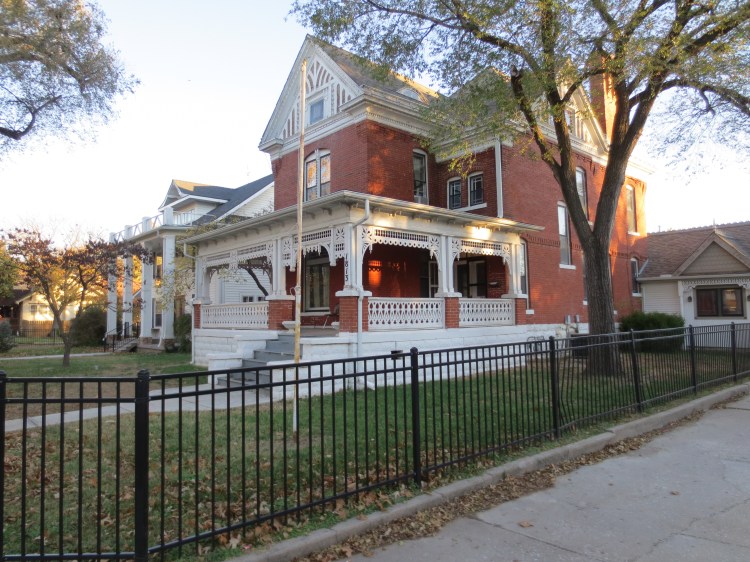
This beauty of a house is the current home of Northfield School of the Liberal Arts here in Wichita, but it was once home to Edmund Stanley, a man heavily involved in Kansas public education and Friends University, located just down the street from the house.
The project is to get the house onto the Register of Historic Kansas Places. There are a lot of steps to get to the Register, and I’m still in the early phases!
UPDATE: I am almost ready to send it to the Kansas Historic Society for review. First step is to make sure they’re interested by sending a questionnaire with my research so far. Just one item to beef up and she’ll be off. My first actual thing as a historian. Feels big.
Property Description:
This Queen Anne home was built in 1887 for Warren A. Wight, by William Sternberg, a prolific builder in Wichita during the boom years in the 1880s. The original Wight-Stanley house is a two-story brick structure with a full basement and unfinished attic resting on a limestone foundation. A one-story addition was added onto the south (rear) of the house around the year 2000 and has a concrete foundation with a crawlspace beneath the main floor. The asymmetrical structure has an irregularly shaped hipped roof with cross-gables, one a dominant front-facing gable. Two brick chimneys remain on the east and west sides of the roof. A continuous band of slightly-overhanging vertical bricks visually separates the first and second stories. The east chimney has patterned masonry and a decorative stone panel. The Wight-Stanley house is an example of the spindlework decorative subtype due to the ornamentation on the one-story, full-width porch. Lace-like brackets and spindlework frieze connect square supports while small brackets accentuate the overhang above.
The interior of the home includes a foyer, living room, dining room, den, bathroom, kitchen, laundry room, and garage on the first floor, and four bedrooms and a bathroom on the second floor. The attic shows charring from a fire, which a 2008 building inspection estimates happened in the 1920’s. The wood trim, flooring, doorknobs, etc., are primarily original throughout the home.
Significance:
The Wight-Stanley house is being nominated to the Register of Historic Kansas Paces under Criterion B due to its association with the fourth owner, Edmund Stanley, who lived in the home from 1901 to 1928. Stanley moved to Wichita in 1898 to become the first president of Friends University and purchased the home on University Avenue shortly after. He and his wife, Martha Stanley, lived in the house until their respective deaths, his in 1928 and hers in 1932.
The home has been tied to the Friends University campus since its construction in 1887. Robert Lawrence sold 150 acres of West Side land to the Christian Churches of Kansas for Garfield University. Twenty-five acres were reserved for the campus, while the other 125 were platted as city lots to be sold to establish the funds for the university. Warren A. Wight, a lumberman in West Wichita, built the home for his family and continued to invest in Garfield University. By the time Garfield closed for good, he had lost almost everything with the crash of the housing market and moved his family to Utah to start over. The house was sold two more times before being purchased by Edmund Stanley, the president of the newly-established Friends University.
Edmund Stanley began his career in education at a young age. Needing to earn money to afford tuition at the academy at Lafayette, Indiana, he took a job teaching school. After he had finished at the Academy, he went to Tennessee to teach at a Freedman’s school there, and eventually relocated to Kansas, where the rest of his family now lived. He continued teaching in rural schools and in Lawrence, Kansas, while he attended the state university. After graduating, he served as a principal in Lawrence, then as the superintendent of schools in Lawrence, then of the entire state of Kansas.
Stanley was very involved in the Society of Friends and in their plans to organize Friends University at the site of the failed Garfield University. When they offered him the position of first president of the university, he accepted and moved to Wichita in 1898. With limited resources and little help, Stanley began promoting the school and getting sponsors so that badly-needed repairs on the building could be made. As enrollment and funds allowed, he restored the Garfield building and set up an excellent college. He oversaw the establishment of sports teams, debate teams, and the alumni association, all within the first few years. He also ensured that the students of Friends received a well-rounded, modern education by offering courses in subjects such as typewriting as soon as it was appropriate. During this time, president Stanley was “untiring” in his efforts to build an outstanding college. Early friends University scholar Juliet Reeve stated that he “poured not only his time and energy, but also his resources into the task, spending year after year more money on the enterprise than he drew from it.“ He was an excellent administrator with clear vision for the school, and when the state released the requirements for standardizing colleges, Friends University had already met most of them, and fulfilled the rest two years before the deadline.
The ten years from 1903-1913 had been “quietly prosperous,” but the next ten were more difficult. Disagreements over the funding of departments and marriages cost Stanley seven faculty members in a time when he was already trying to raise funds for more faculty. When he was unable to secure more funding through the Friends’ Yearly Meeting, the student body and remaining faculty mobilized and raised the money needed to hire the needed faculty and pay for better laboratory and library facilities and a new gymnasium. Despite the students’ success, funding issues were again exasperated when enrollment decreased noticeably due to the first world war. Many students were drafted and as many enlisted during this time. While the last years of Stanley’s presidency were difficult, and the board accepted his resignation on July 5, 1918, he was awarded an L.L.D. by Fairmount College in recognition of his excellence as an educator. After his retirement in 1918, he remained an active member of the Friends University and Wichita communities. He was hit by a car while crossing the street in 1928 and died from his injuries.
Martha Stanley continued to live in the home until her death in 1932. Since then, the home has belonged to doctors, salesmen, Boeing employees, and teachers, and has changed very little, with the exception of an addition to the back side of the house in the early 2000’s, which added a larger kitchen and garage.
The neighborhood around Friends University and the Wight-Stanley house has continued to grow. In 1999, the Delano Neighborhood, Business, and Clergy Associations came together to improve the Delano Neighborhood which includes the University Place addition and Friends University campus. They worked closely with the Wichita-Sedgwick County Metropolitan Area Planning Department to create a development and revitalization plan, and won a neighborhood revitalization planning grant from the Kansas Department of Commerce and Housing to help with further planning. Some of the goals for the larger neighborhood presented in the plan have been met since it was created in 2001, while several others are forthcoming. The Creation of a “University Avenue Historic streetscape” is a project yet to be completed. This will include replacing the concrete sidewalks with brick pavers and installing period lighting similar to that which is on the Friends University campus, to reinforce the connection between the campus and the neighborhood. The plan also laid out guidelines for the exteriors of new and existing structures to maintain the integrity and historic aesthetic of the neighborhood.
Sources:
Hartwell, Richard, Structural Inspection for 1813 W University, April 18, 2008.
Historic Delano Inc. “The Delano Neighborhood Revitalization Plan,” historicdelano.com.
Accessed 11/28/2016. http://www.historicdelano.com/DelanoUnited/DelanoPlan.php
Law/Kingdon, Inc. “Delano Neighborhood Revitalization Plan.” Neighborhood Revitalization
Document, City of Wichita, 2001. https://www.wichita.gov/Government/Departments/Planning/NR/NR%20Documents/
Delano%20Neighborhood%20Plan.pdf. Accessed 11/28/2016.
Miner, Craig. Wichita: The Magic City. Wichita: Wichita-Sedgwick County Historical Museum
Association, 1988.
Nelson, Raymond S. In the shadow of the tower: Friends University: the first 100 years.
Wichita: Friends University, 1998
Reeve, Juliet. Friends University: The Growth of an Idea. Wichita: Friends University, 1948
Sanborn Fire Insurance Maps: 1923
Savage McAlester, Virginia. A Field Guide to American Houses. New York: Knopf, 2013.
Wichita Beacon: 1886-1928
Wichita City Directories: 1886-1952
Wichita Eagle: 1886-1932
 The Marginal Life